
Building on Part 1, where we explored Romanian women through the lens of consumption, longevity, and decision-making power, this second chapter completes the picture.
Using data from the Women in Romania – 2024 Snapshot by Wisemetry, we now turn to three critical dimensions that shape long-term purchasing power: education, participation in the labor market, and income dynamics.
Together, these factors reveal not just who women are today - but how their role in the economy will continue to evolve.
Women are highly trainable, adaptable, and capable of long-term professional development. Official statistics show that a higher proportion of women than men complete post‑secondary and tertiary education in Romania. This indicates a consistent investment in formal education and professional qualification.
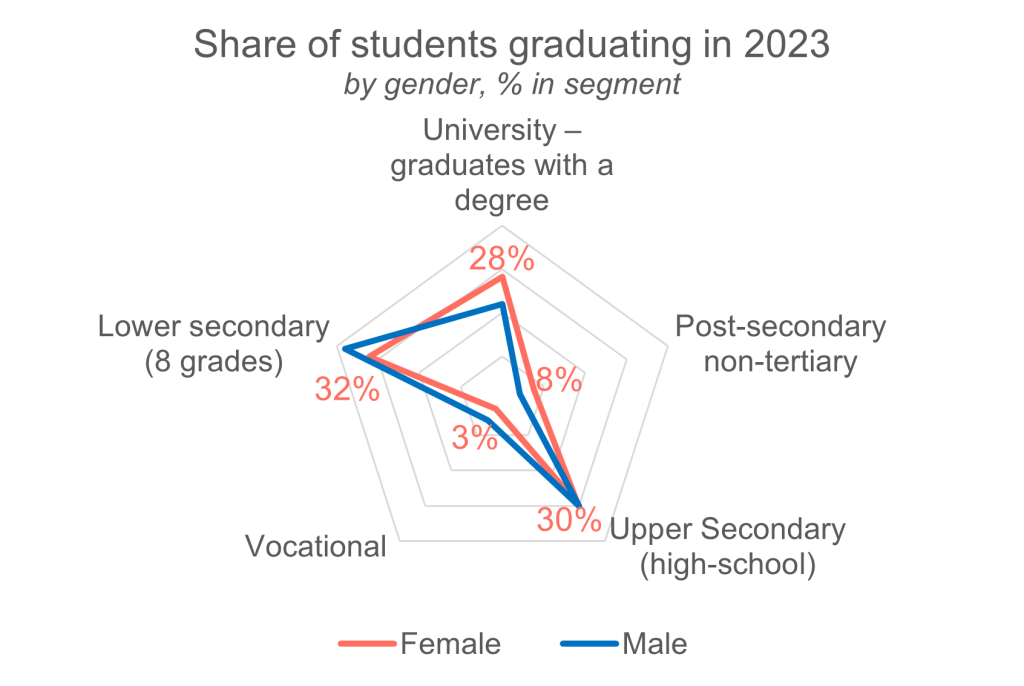
The profile of high‑school graduates confirms this pattern. In 2023, 55% of those who passed the baccalaureate exam were girls, although girls represent only around 48–49% of the population aged 18–19. This gap suggests a stronger tendency among young women to continue education and to pursue qualifications that enable professional autonomy.
This raises an important question:
Is education simply a personal asset, or can it be leveraged strategically by employers and brands?
To answer that, we need to look at how women participate in the economy.
Women represent nearly half of Romania’s labor potential - around 5.9 million people.
When focusing on the civil active employed population, women account for 45% (around 3.5 million people). Although their participation rate is lower than men’s, their contribution is structurally significant for the functioning of the economy.
Nearly 80% of employed women are salaried workers, either in the private sector or in public institutions. Women are over‑represented in: public administration, education, healthcare. Together accounting for around a quarter of female employment. Other important sectors include commerce, hospitality, and various service industries.
Among the remaining 20% who are not salaried employees, most work as self‑employed professionals, while a substantial share are unpaid family workers - reflecting economic vulnerability in certain life stages.
At the same time, their participation is closely linked to broader social policies - especially those related to childcare and family support.
Labor force participation is low in the 25-34 age group, where maternity leave is most concentrated. Average age at first childbirth in Romania is around 27 years, and second births often occur within a relatively short interval.
The highest concentration of salaried women is found in the 35-54 age group, which corresponds to peak occupational activity and career development. However, this overlaps with family responsibilities.
The gender pay gap persists across the entire professional lifecycle and peaks between ages 35-44, reaching approximately EUR 90 compared to the overall average. This is exactly when women are balancing career growth with family responsibilities. After this stage, the gap gradually narrows.
This pattern points to structural constraints linked to career interruptions and work–family balance, rather than to differences in education or capability.
What do these facts mean for EMPLOYERS?
The data points to two major actors who can unlock this potential: employers and brands.
Romanian women bring strong learning capacity, discipline, and long-term commitment. Organizations that recognize this can gain a competitive advantage.
To fully leverage this potential, employers should:
There is also a powerful employer branding opportunity: positioning work not as a trade-off, but as a system that enables both career and personal life.
What do these facts mean for BRANDS?
Higher education levels and professional autonomy imply a greater capacity for evaluating offers and making informed choices. At the same time, combining paid work with family responsibilities creates persistent time pressure.
Brands should:
Brand relevance is closely linked to practical usefulness in daily life.
Romanian women are not a niche audience. They are a structural force in the economy:
Their influence extends beyond their own consumption - to children, partners, and aging parents.
For businesses, this means:


