National statistics often sit quietly in public databases, rarely transformed into stories that truly inform business decisions. At Wisemetry, we believe that "Data is Human". When we look at the 8.3 million women living in Romania today, we aren’t just looking at a demographic segment; we are looking at the primary engine of household consumption and the most resilient part of our society.
This article is based on the Women in Romania – 2024 Snapshot, Wisemetry report, developed using official data published by the National Institute of Statistics. Its purpose is straightforward: to translate data about Romanian women into meaningful implications for brands, employers, and decision-makers.
One of the most striking insights from the data is the "survival gap”. While the national average life expectancy at birth is 77 years, for women, it reaches nearly 81 years. While men slightly outnumber women at birth, the balance shifts significantly after the age of 65. In the 60–74 age group, women already represent about 56% of the population, and the imbalance grows even stronger beyond 75.
These numbers are more than demographics.
Because women live longer, they interact with healthcare systems, financial services, and consumer markets for a longer period of time. Statistically, they are also more likely to live alone in older age, which changes both their needs and their decision-making patterns.
So what does this mean for business?
Now what should brands do?
Longevity alone does not tell the full story. Market understanding improves significantly when we add population size by age group.
In figures, Romanian women are:
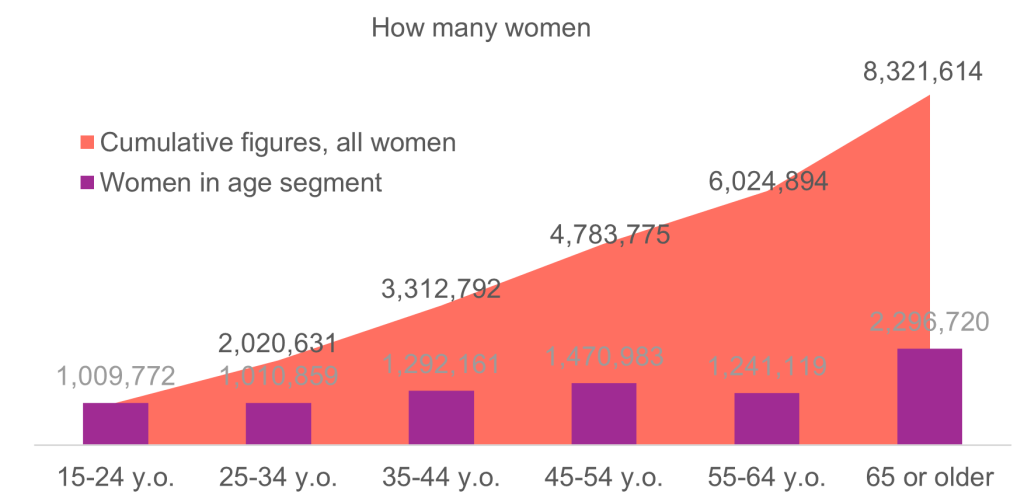
For brands – for example in beauty or personal care – this highlights both complexity and opportunity. Needs differ by age, yet some products remain transversal across life stages. The realistic maximum potential often approaches the size of the entire female population, even if adoption varies by segment.
When evaluating a new product or innovation in terms of business potential, demographic data should be translated into a structured funnel:
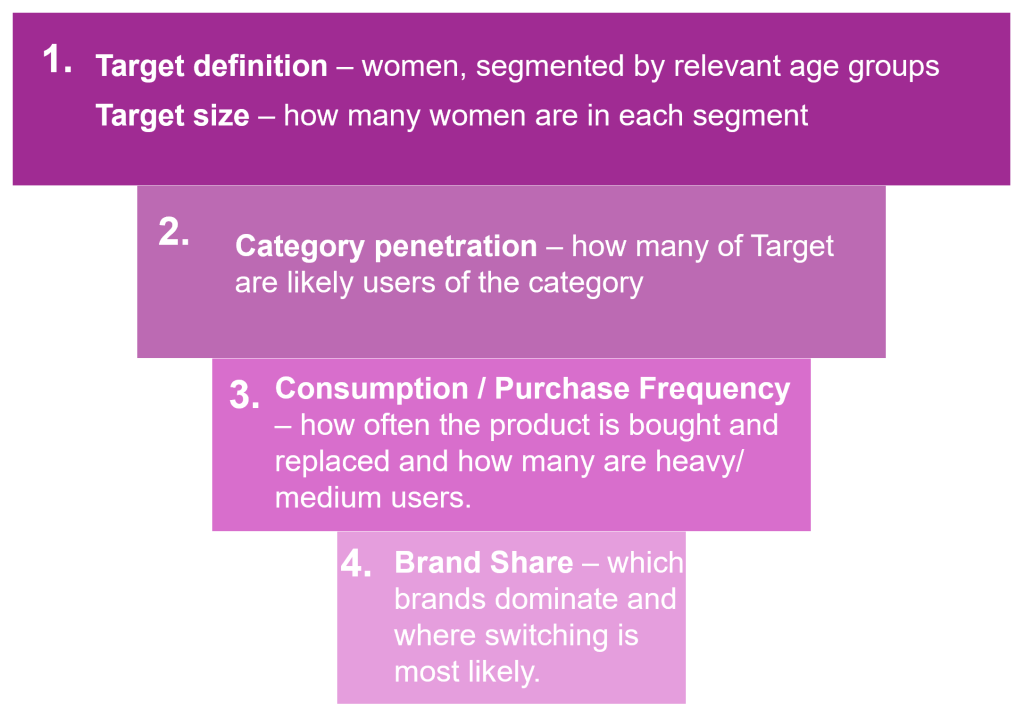
From the second layer onward, additional research becomes essential. Panel data or usage & attitudes studies are needed to move from macro potential to realistic forecasts.
When national demographic data is cross-referenced with digital usage statistics, women’s profiles become richer and more actionable.
Internet usage in Romania is near saturation in the 16–54 age group. Over 85% of women actively participate in social networks and use online voice or video calls.
Compared to men, women are more likely to:
They are less likely to:
These patterns suggest not aversion, but selectivity.
So what does this tell us?
Implications for brands and service providers:
Romanian women are the nucleus of household spending. They are psychologically more open to change and tend to adopt new trends with greater ease than men. They don't just consume; they influence. They recommend brands, curate the household "menu" and dictate the lifestyle standards of the families they lead.
Understanding these demographic and digital baselines is the first step in moving from data to insight. However, to see the full picture, we must also look at their role in the economy - not just as consumers, but as the country's most educated workforce.
Download the report hereThis article explored women through the lens of consumption potential. In the next chapter, the focus will shift to women as a labor force and economic contributors, because purchasing power and professional participation are deeply interconnected.


